
FEATURE/WILDLIFE WELFARE
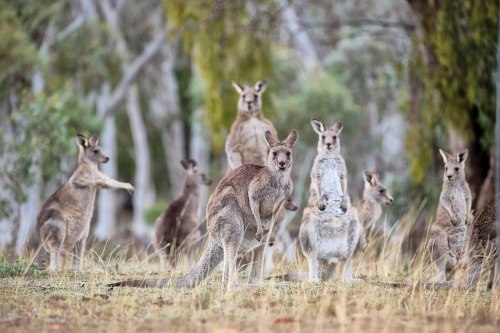
A controversy in the wildlife sector has recently blown up on social media about the Animal Rescue Cooperative (ARC). ARC, a charity that distributes donated pet food to companion animals and wildlife in need, has been called out for distributing kangaroo-based pet food (KPF) while at the same time running programs to help sick, injured and orphaned kangaroos. The public charity has defended its actions claiming ‘activists’ highlighting the conflict of interest are ‘bullies’, ‘haters’ and ‘liars’.
ARC is supported by, and thus promotes, companies that profit from kangaroo-based pet food (KPF), for example, Petbarn and Mars Petcare and hands out KPF to cats and dogs in need. As a wildlife charity, ARC’s partnering with kangaroo meat profiteers is problematic. Wildlife advocates have highlighted ARC’s conflict of interest in distributing donations of KPF food to companion animal shelters and the public while at the same time running programs to protect and care for kangaroos. On September 1st, 2022, Peter Day, a kangaroo advocate and wildlife shelter operator in NSW, under his moniker, Peter Leo Harry, posted his outrage on Facebook about ARC’s conflict of interest. He claimed ARC was sending a message of endorsement for KPF because “if an animal charity like ARC provide kanga meat, then it must be ok to buy it!”. In Day’s opinion, “By handing out free kangaroo meat, ARC are inadvertently contributing to the mass slaughter and suffering of our beautiful kangaroos”. Other wildlife advocates agree.
Wildlife rescuer Ian Slattery believes “while ARC may not be out there deliberately sourcing kangaroo products”, by “accepting it [KPF] knowingly and then giving it out, they are giving their tacit approval to the industry”. ARC cares about animals and has impressive initiatives that feed thousands every year, from animals impacted by natural disasters to helping the pets of domestic violence survivors. The charity’s work is much needed and appreciated. But Day thinks, “ARC refusing to accept or distribute kangaroo meat products places them at risk of upsetting their suppliers and so ARC risks losing major sponsors”.
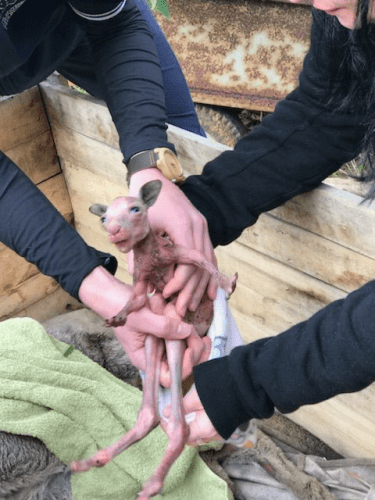
KPF is a product that profits from killing macropods and is associated with the inhumane maiming of kangaroos. The Australian government supports the killing or ‘harvesting’ of kangaroos and outlines in their 2020 National Code of Practice kangaroos “be killed with a head shot“. However, according to Slattery, not all kangaroos are killed to code; thus, he strongly advocates against the commercial kangaroo industry. Over the past 13 years, Slattery’s been called upon when injured, but mobile kangaroos need tranquilising using a dart gun – he is one of a few licenced darters in Victoria. He said members of the public call him out the morning after shooting, where he finds kangaroos “with shots to the stomach, limbs blown off, and jaws shot off. Some animals are still alive, and “of course, orphan joeys standing next to their dead mothers that we have to try and then capture. So, I go out to those because I can dart. So that’s commonly what we see after a night of kangaroo killing”. Slattery attends such cases between six to ten times a year.
Wildlife protection, and killing, are regulated by state authorities such as Victoria’s Department of Environment, Land, Water and Planning (DELWP). In their 2019 Kangaroo Pet Food Trial Evaluation Report (KPFTER), DELWP reported that they don’t track shooters or routinely inspect their work. They added that “reporting from processors and landholders is delayed”, making the welfare of animals killed in the field (in the dark) almost impossible to regulate. The code requires joeys found in their dead mother’s pouches to be removed and killed via “decapitation or cervical dislocation”. Older, partially furred or fully furred joeys should be bashed to death via a “concussive blow to the head”. In the report, the government acknowledges that at-foot unweaned joeys “are likely to experience severe suffering and have a poor chance of survival” after losing their mothers, so they should be “euthanised wherever possible” either via a blow to the head or shooting them in the head or heart. However, many at-foot joeys flee the chaos of hunting, making them difficult to shoot. Far too many joeys die slowly in the elements, starving or falling prey to predators.
For these reasons, the RSPCA recently banned selling KPF in their retail outlets due to concerns about the inhumane treatment of kangaroos. The RSPCA stamps its approval on many meat products, including intensively farmed animals, so when the peak animal welfare body flagged welfare concerns about sourcing kangaroo meat for pet food, it was a big deal.
Kangaroo meat is controversial, particularly within the wildlife sector. Many find ARC’s conflict of interest a current concern. Debbie Gwyther-Jones, a volunteer wildlife rescuer in the Macedon Ranges Victoria, told me that she recently rescued three kangaroos in six days with gunshot injuries. Gwyther-Jones, who has received support from ARC in the past, said, “It seems ridiculous to be against the commercial shooting of kangaroos but be distributing pet food containing kangaroo and thereby supporting the industry… I think the organisation has grown substantially, and in the process, lost sight of their core values”.
In mid-September, after the issue came to light on social media, ARC surveyed the wildlife volunteers they assist. According to ARC, “It [the survey] was completed by hundreds of rescuers, many who are senior leaders in the kangaroo community”, and of the ‘hundreds’, 83% were in favour of giving out KPF. A further 10% of the 83% wanted kangaroo meat ingredients covered up on KPF donations to pet owners. As a wildlife advocate and someone who opposes kangaroo products, I was first alarmed that a charity dealing with the care of wildlife and companion animals was handing out dead kangaroos made into pet food, even in small, donated amounts. But more disquieting was that kangaroo rescuers and shelters supporting ARC had seemingly given their tick of approval. ARC’s survey asked, “what do we do with Kangaroo that has ALREADY arrived in a donation mix” (sic). The options to answer were:
1. Give it out anyway as no point wasting food
2. Give it out anyway but cover any reference to Kangaroo
3. Throw it in the bin
4. Other.
I can’t help but wonder if ARC had given the “bin it” option a qualifier of something like, “because kangaroo pet food causes kangaroos to suffer” or “as wildlife helpers, it’s a conflict of interest to condone handing out food containing the very native animals you care for”, they may have had a different statistical outcome.
For some, these contradictory actions are due to ARC using the survey to retroactively give themselves permission to do what they want. Evidently, ARC may have continued to distribute kangaroo meat no matter what the survey results justified, considering only 10% of those surveyed recommended covering kangaroo ingredients on donated KPF, but ARC covers them up anyway.
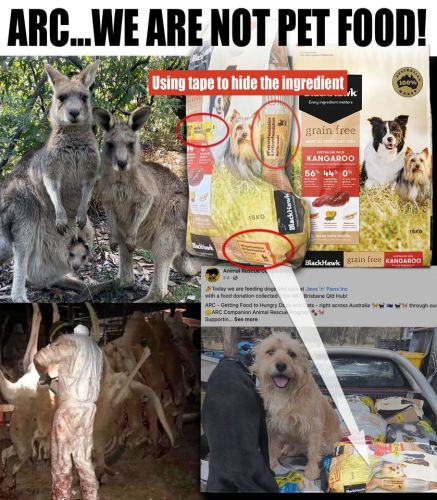
Interestingly, ARC’s Kangaroo in Pet Food Policy, developed after their survey, doesn’t mention the perils of the industry or why wildlife advocates are highlighting the issue. Instead, it gives substantial space to explain why they will continue to distribute KPF and also, in a revealing Q&A section, how wrong ‘activists’ are. ARC admits that they handpick who they help, which raises ethical questions about the organisation’s power to silence people. Animal carers with genuine concerns about the charity’s actions or governance may remain silent out of fear of missing out on much-needed ARC donations. ARC should protect its brand as a public charity but should be open and transparent and not censor those who voice respectful concerns. ARC blocks conversations on Facebook, banning those who have commented on this issue. As a result, the words of ARC and their supporters gain a deceptive power through strength in numbers and the illusion that everyone agrees.
Dominic Ward from the Granite Belt Wildlife Carers Group, a collective of wildlife volunteers who look after possums and gliders – and currently receive material support from ARC – thinks “Censorship in any form should be rejected”. Dominic knows ARC does “great work, important work”, but he thinks “they’re confusing their role and failing as a protector of macropods” and wonders if ARC is “being used by the kangaroo industry as a source of validation or ‘greenwashing'”. He thinks for the charity, “To operate as a truly ethical entity – which they can and should be – they need to set clear boundaries regarding their association with native animal products and rigidly uphold these. There’s no other way”.
ARC’s reasoning that they “wont (sic) waste the food and have an animal die to be put in the bin” echoes the industries’ reasoning for the KPF trade. Rather than a way to ‘reduce the waste’ of kangaroo meat from animals that ‘needed’ to be killed, there is evidence that profit drives the wildlife trade. Sustainability quotas, calculated by government scientists, allocate how many animals they think can be killed sustainably. However, there are questions about why quotas are not being met and why professional shooters actively search for kangaroos to kill. If reports are accurate that kangaroos are in ‘plague’ numbers in Victoria, why then, in 2022, did the Victorian Kangaroo Alliance report hundreds of “properties wanted” and “free pest control” Facebook posts from shooters Victoria-wide begging for access to private land? After DELWP provided damning evidence of industry corruption in their 2019 KPFTER and catastrophic bushfires wiped out billions of native animals on the east coast, the Victorian Labor government increased kangaroo kill quotas to a staggering 191,200 in 2021.
Economic benefits may cloud the government’s judgement because withstanding concerns about animal welfare and declining kangaroo populations, under the commercial harvest (KHP) and ATCW [non-commercial] permit program, they recommend “a total take of 185,850 grey kangaroos” for 2022. Wildlife researcher Peter Hylands reported that “kangaroo numbers are in decline across the continent…and they [government] keep pretending nothing is wrong. This also puts governance standards from these state-based and ‘so called’ environment departments in a very poor light”. Kangaroo quotas are not being met; many believe this is due to numbers declining in the wild. A fact evident by the Victorian government closing commercial killing zones in the Mallee and the Northeast in 2021. There are also concerns from within the government about their ability to manage the system, protect kangaroo welfare, and prevent local extinctions and more widely wiping out the species. In October 2021, the NSW legislative council released a damning report titled, Health and wellbeing of kangaroos and other macropods in New South Wales. The committee’s chair Cate Faehrmann MLC introduced the report with the following:
The robustness of the science and population estimates behind setting quotas for how many kangaroos may be harvested has been called into question through this inquiry. Without independent oversight and greater transparency, we cannot have confidence that the government’s kangaroo management program is not contributing to potentially devastating declines in some kangaroo populations.
DELWP’s 2019 KPFTER alarmingly noted that commercially killing kangaroos “has clearly changed the behaviour of some participants”. They found that some landowners were choosing to kill kangaroos before non-lethal measures to protect property and crops were exhausted. There were also reports of “shooters encouraging landholders to apply for KPFT [Kangaroo Pet Food Trial] authorisations, providing incentives and even completing applications for them”. Authorities and wildlife rescuers alike know that’s a whole lot of suffering going on. Kangaroos are killed for reasons other than ‘need’ and kangaroo petfood represents much more than just using a ‘resource’ that would otherwise go to waste. Nonetheless, the Victorian government’s Kangaroo harvest quotas for Victoria 2021 report suggests privatising the system entirely, claiming an increase in the commercial killing of kangaroos will see “improved animal welfare outcomes and economic benefits for the state’s commercial kangaroo harvesters”.
So, what does this all have to do with ARC? In one word: everything. ARC note they only distribute around two bags of KPF per five hundred bags of donated pet food. However, Cienwen Hickey, Wildlife Protection Advocate Australia at The Center for a Humane Economy, claims this is a “deceitful fabrication”. Many have noted social media posts by ARC featuring pictures of more than one bag of KPF or at least one bag in a small load donated to pets. But whether ARC hands out one bag or a hundred, with ingredients covered up or not, is beside the point for many kangaroo advocates. The issue is not a matter of quantity; instead, it’s about whether a charity that helps wildlife has a conflict of interest in distributing even one bag of KPF.
The kangaroo industry represents a unique problem for wildlife advocates who place a greater significance on the value of native animals. Kangaroos feature on the Australian coat of arms, and they are a spiritual totem of Aboriginal peoples. Unlike domestic animals, kangaroos have lived in Australia for millions of years. They have intrinsic value to ecosystems, the landscape and the ecotourism industry that’s worth far more to the economy than the KPF trade. Furthermore, ARC’s actions inhibit consumer choice when ingredients are covered up. Pet owners who wish to boycott KPF may inadvertently feed their pets kangaroo donated by ARC.
The KPF, agricultural and retail industries rely on consumers. The kangaroo industry, like any other industry, is based on supply, demand and making a profit. Petfood sponsors donate to non-profits as a relatively cheap way to advertise their products and gain valuable consumer trust. Californian Marketing Professor Michal Strahilevitz’s research into ’cause-related marketing’ reported that businesses that engage in ‘strategic giving’ benefit from an improved image and boosted sales. Similarly, Chicago scholars Menon & Kahn claim in a 2001 paper that consumers are more likely to buy products from businesses “that share their own values and ethics”. So, according to Menon & Kahn’s logic, multinational pet food companies that profit from the commercial killing of kangaroos gain a ‘competitive advantage’ when they donate to ARC by improving consumer trust through enhanced reputation and credibility. KPF producers couldn’t get better promotion than having a wildlife organisation, such as ARC, distribute their goods to new consumers. ARC promotes KPF profiteers by promoting their logos in advertising, sharing their names in hashtags online, and handing out KPF.
ARC sends a message to the public, pet owners and companion animal shelters that kangaroo is an acceptable meat to provide to their pets. NSW marketing consultants LMHR acknowledge that giving to charities is good for business, “Giving back to your community will help you build stronger relationships with your existing customers and potentially gain new ones”. Gaining new customers is also a key focus of the KPF industry and more reason for ARC to reconsider its distribution of KPF.
Disclaimer
I contacted ARC via email with a detailed outline of my story and eight related questions, but they didn’t respond; thus, all information about ARC was quoted from their website and social media and was correct at the time of writing.
 Eve Kelly
You must be logged in to post a comment.